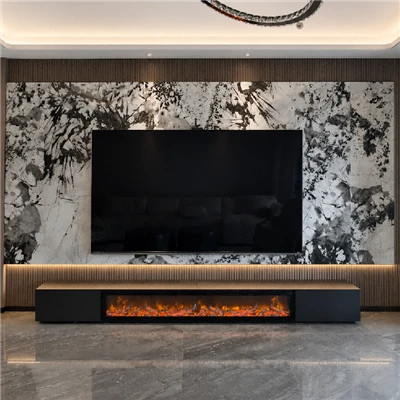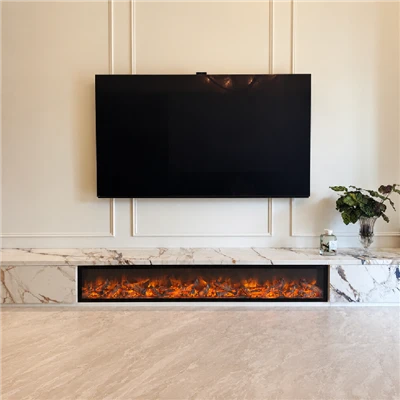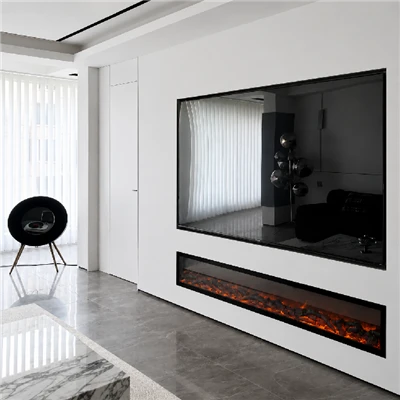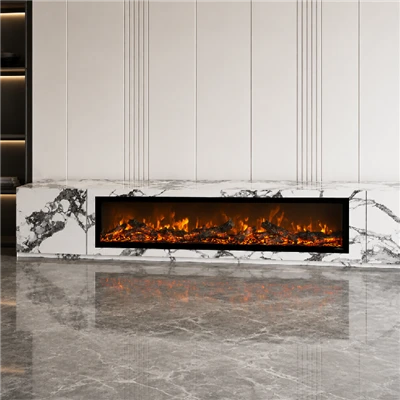


A water vapor fireplace is a decorative fireplace that produces a flame image from water instead of fuel. There is no gas, no ethanol, no wood and no flue. The effect is created by an ultrasonic atomizer, a controlled airflow and a row of LED lights, and the result is a three-dimensional flame that moves and glows like a real fire without producing heat or smoke.

How the flame is produced
The process has three stages. First, an ultrasonic transducer vibrates at high frequency in a shallow water tank and breaks the water into a very fine mist. Second, a small blower lifts that mist into the flame chamber and keeps it moving along the length of the unit. Third, LED strips light the mist from below. Because the light is scattered by thousands of water droplets, the flame has depth: you can see through the outer edge, the core stays bright, and the tips flicker as the mist rises.
Why it looks different from an electric fireplace
An electric fireplace shows a lit image behind tempered glass. A vapor fireplace has no image - the flame exists in the air itself, which is why it reads as a real fire from an angle and from a distance. The trade-off is that the effect depends on air movement: a strong draught from an air conditioner or an open door will push the flame sideways, so the unit should not sit directly in front of a vent.
What it means for the project
Because there is no combustion, the fireplace needs only a power supply of 220–240 V and a way to fill and drain the water tank. Standard body dimensions are 240 mm wide and 160 mm high; the cut-out is the nominal length minus 30 mm, 210 mm wide and 170 mm high, with at least 230 mm of depth. Custom lengths from 700 mm to 3000 mm are available, and the required power rises with length, from 100 W to 370 W.
Chengshuang builds water vapor fireplaces in Foshan, with CE documentation, OEM/ODM support and a one-unit minimum for sample rooms.